

My friend Gary Marcus put out a nice blog post earlier this week titled “Leopold’s Folly,” which uses the late-July implosion of Leopold Aschenbrenner’s tragicomically-named Situational Awareness hedge fund — $45 billion of assets compressed to roughly $10 billion in a matter of days, the whole public book sold to Citadel under margin pressure — as a symbol for the financial structure of the entire AI economy.
Gary’s essay is vivid and, on its central financial observation, more right than his critics will want to admit. All the circular financing in the modern AI and hardware world does have a Ponzi-esque smell to it, at least on the surface — and it’s clear there are some eventualities where this whiff leads to a Ponzi-crash-style reality.
But his post is also a somewhat limited investigation of a much more complex reality. I’ll try here to provide a more nuanced consideration. What are the factors determining when circular finance leads to vicious rather than vicious cycles? What are the plausible economic trajectories here, what actually causes the pathology Gary describes, and what would change the trajectories?
I’ll start by laying out the situation as Gary presents it, and say what I think is right and what is overlooked in his framing.
I will then dig into the underlying cause of the situation he described, which I’ll argue is neither stupidity nor fraud but basically a geopolitical prisoner’s dilemma between the US and China that makes reckless bet-sizing an equilibrium rather than an error.
To frame this argument carefully, I’ll look at three potential scenarios for AI progress — a neo-Kurzweilian fast path, a moderate techno-optimist path, and the AI-pessimist path where Gary turns out right about the technology — and work through the likely economics of each.
Even more interestingly (at least to me), I will then re-run all three scenarios under an additional assumption close to my own heart and my own life’s work: that decentralized AGI, of the sort we are building with OpenCog Hyperon on ASI:Chain across the ASI Alliance, succeeds strongly — running on a global network spanning many nations, relying far less on the latest GPUs and not at all on hyperscaler balance sheets, and sitting slightly ahead of Big Tech’s frontier the way a couple of the leading labs sit slightly ahead of everyone else today.
My bias here is so obvious it probably doesn’t need explicit flagging: I have spent much of my career arguing for, and building toward, decentralized AGI, so of course the last section is where my own agenda enters. Please do think all this through for yourself. However – I would note that the analysis of the first three sections stands on its own … and the conclusions of the last section follow from the same machinery — I’m not smuggling in the answer, I’m applying the framework to one more assumption and reporting what comes out.
My headline conclusion, from some basic economic analysis is:
A decent-sized financial crash in the next couple years is the modal outcome given recent current economic behaviors, pretty much regardless of whether AGI comes in 2029, 2035 or later
One factor that could cause this NOT to happen would be advent of decentralized AGI as a major factor — because the economic dynamics of decentralized networks are different in relevant ways…
I apologize in advance for the fairly detailed case-by-case analysis; I’m aware not all readers will have the patience for it…. but I don’t see how to avoid going at least this deep (and ideally one would go way deeper) … these matters are “not rocket science” let alone AGI engineering, but they’re not utterly trivial and obvious either….
The situation as Gary presents it
Gary opens his post charmingly enough with check-kiting, the classic bank fraud in which you write checks between accounts at different banks, exploiting the clearing delay — the “float” — so that each account looks funded by checks drawn on the others, none of which are backed by real money. Kiting is a timing crime rather than a valuation crime: the scheme looks solvent at every instant on paper, and it becomes fraud only because the deposit that would settle everything is never going to arrive. The structurally identical but perfectly legal activity is bridge financing — spend now against credible future cash flows — and which of the two you are doing is determined only in retrospect, by whether the deposit shows up before the checks clear.
Gary is careful to say the generative AI industry is not literally kiting; his claim is more-so that the circular deal structure has similar dynamical and psychological characteristics. And the circularity is real. The Bloomberg diagram he reproduces — Nvidia at five trillion of market cap with investment, hardware, and services arrows running to and from OpenAI, Anthropic, Microsoft, Oracle, CoreWeave, SoftBank, xAI and the rest — depicts a web in which chipmakers invest in labs that buy their chips through cloud providers the chipmakers also back.
The float, meanwhile, has gotten enormous and has acquired a measurable clearing schedule. Hyperscaler capital expenditure is running toward $700 billion this year; analysts at Morgan Stanley and J.P. Morgan project on the order of $1.5 trillion of new tech-sector debt over the next few years to keep funding the buildout; estimates of Big Tech’s off-balance-sheet AI commitments run to $1.65 trillion; and by PIMCO’s numbers, hyperscaler capex is on track to consume something like 94% of the operating cash flow of the companies doing the spending. Tech borrowing has reportedly reached a quarter of Treasury issuance, five times last year’s share, and Gary reads the Treasury’s newly doubled long-end “liquidity support” buybacks as what they rather look like — the sovereign writing one more check to keep the kite aloft.
Gary’s deeper argument arrives via the Kelly criterion from finance theory – if you’re not familiar with it, please read this quick summary I prompted up for you. The Kelly criterion is a formula from the 1950s that tells a gambler what fraction of their bankroll to stake on a favorable bet so as to maximize long-run compound growth. Betting more than the Kelly fraction — going even a little beyond “Full Kelly” — raises your winnings if the bet pays but guarantees eventual ruin if you keep doing it, because a single bad draw can wipe you out before the favorable odds have time to operate. Aschenbrenner’s fund was an almost laboratory-pure demonstration: reportedly levered around 400% on a thesis (AI infrastructure goes up) that may well still prove correct in direction, he was destroyed by a six-week sector rotation — what Gary calls the July Swoon — that a fractionally-sized version of the same portfolio would have shrugged off.
Gary’s rhetorical/conceptual move, following a post-mortem from Bill Gurley, is to scale this up: the United States as a whole — its companies, its investors, increasingly its government — has gone Full Kelly on generative AI, each entity in a long chain leveraging itself to the hilt on a single correlated play, with 87.5% of recent venture dollars flowing into AI and the banks, pension funds, and effectively the Fed now wired into the same trade.
Where Gary is right, and where the argument doesn’t even need his AI skepticism, is exactly here. The Kelly point is a claim about bet sizing, not about the bet’s merits, and it survives any view of AI timelines: even someone who fully believes AGI is coming in 2029 should not want their entire civilization’s financial system levered to the precise month it arrives, for the same reason that a poker player with a strong reason to believe he has the best hand at the table still shouldn’t bet the mortgage. The correlation observation is right too — the circular deal web drives the effective number of independent bets in the whole AI complex toward one, so the apparent diversification across dozens of companies is no diversification at all.
Where Gary’s essay overreaches, it seems to me, is in the implicit inference from financial fragility to technological pessimism — the suggestion, running under the surface of everything Gary writes on these topics, that the coming financial reckoning will also be the refutation of the technology. In fact I believe these are close to orthogonal questions.
As I’ll argue below, a financial crisis in the 2027–2030 window is arguably the modal outcome under fast AI timelines, moderate ones, and Gary’s pessimistic ones alike, which means the crash, when and if it comes, will carry almost no evidence about AI technology itself. Leopold himself is the proof case: his fund blew up inside a world that may yet turn out to be the fast-AGI world he predicted. Leverage adjudicates timing; it says next to nothing about the terminus.
Why Full Kelly has happened here: the geopolitical prisoner’s dilemma
Gary’s framing — “we have lost sight of Diversification 101,” recklessly and carelessly — treats the national over-bet on LLMs and associated hardware as a collective failure of prudence. I think this misses the actual core mechanism underlying what’s happening – and I also think the mechanism is where the analysis gets interesting … because the over-bet is not a mistake anyone is free to correct. It is an equilibrium of a larger system.
Start with the aggregation problem. Each firm in the circular diagram sizes its bet against its own balance sheet, roughly rationally given its own survival constraint. But because the deal web correlates everyone with everyone, the aggregate position is the sum of individually-sized bets on what is effectively a single coin flip — individually sensible sizing that adds up to a collectively over-Kelly position, with no actor anywhere in the network whose job it is to manage the network’s total exposure. That alone would produce over-betting. What locks it in is the layer above the firms: the United States and China understand themselves to be in a race for the most strategically consequential technology in history, and in a race perceived as winner-take-most, prudent sizing is strategically dominated. If you cut your bet to protect against financial ruin and your rival doesn’t, you survive the financial draw and lose the strategic one. Both sides sizing down is better for both than both sides going all-in — and both sides going all-in is the Nash equilibrium anyway. That is a prisoner’s dilemma over bet sizing, and it means Gary’s prudential advice, however correct, is addressed to actors who are not free to take it.
Contest theory — the branch of economics that studies races and tournaments — adds a grim quantitative footnote. In a symmetric contest between evenly matched players, equilibrium expenditure dissipates the largest possible fraction of the prize: two rivals who each believe they can win will, between them, spend an amount approaching the entire value of the thing they’re racing for. If, as I’d guess is what will happen, progress toward AGI runs at roughly comparable rates in the US and China regardless of which scenario we’re in – then the racing structure guarantees that a very large share of whatever AGI is worth is being pre-spent on the competition to own it.
The trade war then reshapes the flows in ways that mostly make the American float harder to fund. The export-control regime has functioned as inadvertent industrial policy for the rival: China’s AI-chip self-sufficiency has gone from roughly 20% in 2023 to over 40% this year, with Morgan Stanley projecting something like 85% by 2030 and credible estimates that Huawei could cover half of China’s domestic compute demand by 2028 — while Nvidia’s China revenue collapses toward zero. So the controls simultaneously shrink the external demand pool available to service American debt and guarantee a protected home market that amortizes China’s competing capital stock.
The two buildouts also sit on entirely different financing architectures — the American one private, levered, and market-cleared, failing acutely when it fails, via margin calls and fire sales; the Chinese one state-directed and fiscally absorbed, added to procurement lists under the 15th Five-Year Plan, failing chronically when it fails, via overcapacity and deflation quietly folded into state banks. Same overinvestment, two diseases: one cardiac, one metabolic. And China has a low-cost weapon aimed directly at the American margin structure — open-weight models, which have reportedly overtaken US models in global downloads, and which compress exactly the frontier margins the American debt is priced on, at essentially zero carry to a state that doesn’t answer to quarterly earnings.
Two more pieces complete the geopolitical picture. Taiwan — TSMC — is the single physical asset on which both national bets and both categories of risk are jointly written, the covariance term connecting the financial scenarios to the military one. And the sovereign has become the outer bank in the kite: the US government’s principal asset is the present value of future tax revenue, which makes it structurally long AGI whether it wants to be or not — hedged if the technology arrives, doubly exposed if it doesn’t, un-margin-callable but very much inflation-callable.
There is a final irony that Gary, to his credit, gestures at with his title. The securitized framing that converted a commercial technology bet into a national-survival bet — the framing that makes Full Kelly the equilibrium — traces in significant part to Aschenbrenner’s own “Situational Awareness” essay. Leopold’s Folly is downstream of Leopold’s manifesto: he supplied the strategic logic for the national over-bet, then instantiated it personally at 400% leverage.
Three future scenarios
What I aim to do in this post is give a more detailed and in-depth analysis of the situation Gary is alluding to. In order to attempt this in a reasonably tractable way, I’ll consider here three trajectories for the underlying AI technology, spanning most of the credible probability mass. In all three I’ll assume, per the argument above, that US and Chinese progress runs roughly in parallel.
Scenario 1, neo-Kurzweilian: human-level AGI (HLAGI) around 2029, with artificial superintelligence within roughly three years thereafter.
Scenario 2, moderate techno-optimism: exponential progress with commensurate industry-by-industry transformation along the way, HLAGI around 2035, ASI a decade or so after.
Scenario 3, the pessimists vindicated: AI transforms software development, graphic arts, portions of science and customer operations, and then plateaus as a general-scope technology — a large industry, but not a new economy.
The analytical machinery I will use to explore all three is the same:
I look at the economic system’s obligations — debt service, leases, and the replacement of accelerator fleets that lose competitive economic value in perhaps three to five years — as if they define a clock: the capex of 2025–2026 must be earning its keep, and must be refinanced or replaced, by roughly 2028–2030.
AI revenue defines a curve racing that clock.
Solvency, for the system as a whole, means the credible present value of the revenue curve exceeding the obligations coming due at each refinancing gate.
Today’s gap is stark — AI-native revenue plausibly in the low hundreds of billions annually against $500–600 billion a year of AI-specific capex — so everything turns on how fast the revenue curve grows relative to the clock.
The three scenarios are simply three revenue curves run against one roughly fixed schedule of obligations.
One recalls the vocabulary of the economist Hyman Minsky, who taxonomized financial structures by whether
cash flows cover obligations (hedge finance)
cover interest but not principal (speculative finance), or
cover neither so that survival requires perpetual new money (Ponzi finance).
In this language, one may say the same AI balance sheet is one of the three – hedge, speculative or Ponzi – depending on which revenue curve nature selects…
I am aware of the simplifications involved in this sort of standard economic analysis, and indeed last year I developed some unique math for more incisively analyzing future economic and political scenarios, using an extension of Emad Mostaque’s “intelligent economics” to incorporate Schrodinger Bridge metrics gauging the shortest paths from initial to terminal conditions (see Hyperintelligent Economics, Judging the Journey, Weaving Toward BGI). I think this sort of sophisticated approach would be highly applicable here, but I haven’t yet taken the time to mess with it – instead I have just deployed plain old super-straightforward economic accounting. A more incisive dynamical analysis will be interesting to carry out when I find the time to shepherd some agents through it … but I doubt it will contradict the basic conclusions presented here, it’s more likely “just” to add further detail and nuance.
The likely economics of each scenario (without decentralized AGI)
I will now walk through how the economics looks likely to pan out in each of my three scenarios…. This is of course a mix of intuitive thinking and simple quantitative modeling, not highly rigorous science. It’s hard to do fully rigorous economic science about something involving so many new things and so many unknowns – but for sure one can do a better job than I do in this post. I would love to see some serious nonlinear-dynamical econometric modeling of these topics. But barring that, I will be immodest enough to suggest that the depth of thinking I pursue here goes significantly beyond most of what I see in the media or the punditocracy on these topics ;p …
The basic economic calculations on which the following graphs and conclusions are based can be found here, for anyone who wants to poke through.
Scenario 1: the deposit clears — then the state arrives
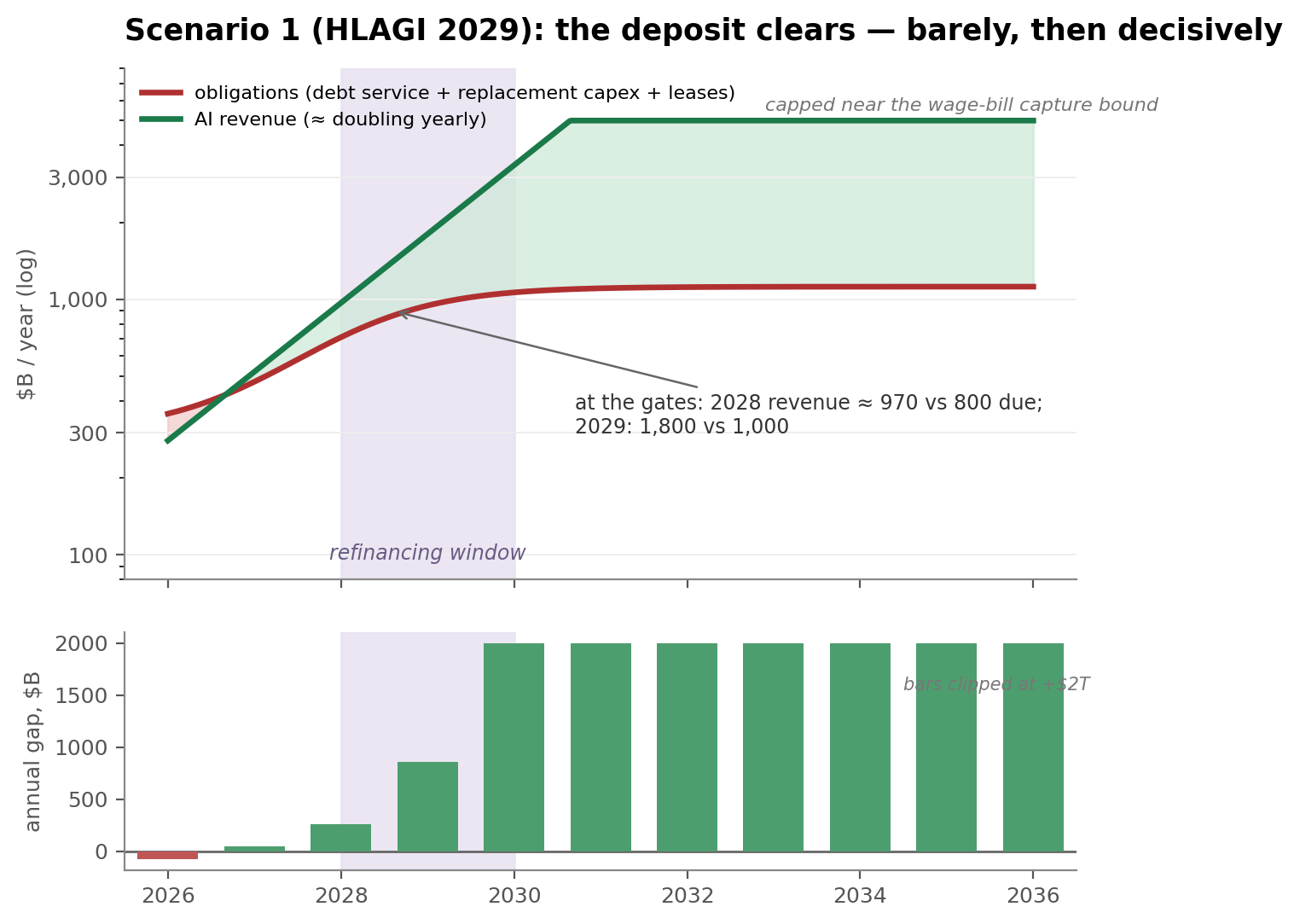
Obligations vs. revenue under HLAGI-2029, in $B/yr on a log scale; the lower panel shows the annual surplus or shortfall. Revenue roughly paces obligations through the refinancing window — clearing barely in 2028, decisively from 2029 — before the endgame politics arrive.
If HLAGI arrives in 2029, the addressable market stops being “software tools” and becomes some significant fraction of the global wage bill — order of $50 trillion a year …and even single-digit-percent capture makes today’s capex look conservative in hindsight, the way transcontinental railroad spending looked conservative by 1900 (but far more so). The kiting accusation dissolves retroactively; it was bridge financing after all.
But even the winning branch is messier than the Kurzweilian imagination tends to suspect, for three reasons.
First, surplus capture is not guaranteed to the people holding the capex: if intelligence commoditizes — several labs at the frontier, open models close behind, inference prices collapsing — then the enormous consumer surplus of AGI can coexist with poor returns on depreciating GPU fleets, the way transformative aviation coexisted with a century of aggregate airline losses.
Second, the transition quite possibly breaks demand before it breaks supply: HLAGI in 2029 means severe wage displacement in cognitive sectors starting well before 2029, likely before political systems build redistribution machinery, and a collapse in labor income is a collapse in the consumption that AI-augmented firms sell into — a demand-side crisis inside a supply-side miracle.
Third, under the parity assumption this scenario goes terminal geopolitically: two states approaching ASI in the same window is the classically unstable configuration, with incentives for preventive action and Taiwan as the tripwire, and the likely economic regime is mobilization — compute securitized or nationalized on both sides, solvency constraints suspended, financial repression as policy. (Successful decentralized AI may fix this, but we’re ignoring that till later.)
Even in the scenario where the bet pays off, in other words, the private holders of the levered claims may be expropriated by victory rather than bankrupted by defeat. The devil will depend on many details. And note the timing: the interest-rate feedback and the inflationary interim mean even Scenario 1 probably passes through a nasty 2027–2028 squeeze — the Kurzweilian world and the Marcus world are observationally similar for the next twenty-four months, which is worth saying loudly.
(You’ll note I have intentionally not inserted an “HLAGI by 2027” scenario here, though I don’t think it’s incredibly unlikely – in that case the bet probably pays off even more compellingly, because the big payoff comes even before the bill comes due… so it’s a very interesting scenario from many perspectives, but not so much from the “circular financing” angle. In this scenario all the circular financing will look in hindsight moderately smart but overly conservative.)
Scenario 2: solvent in present value, illiquid at the gate
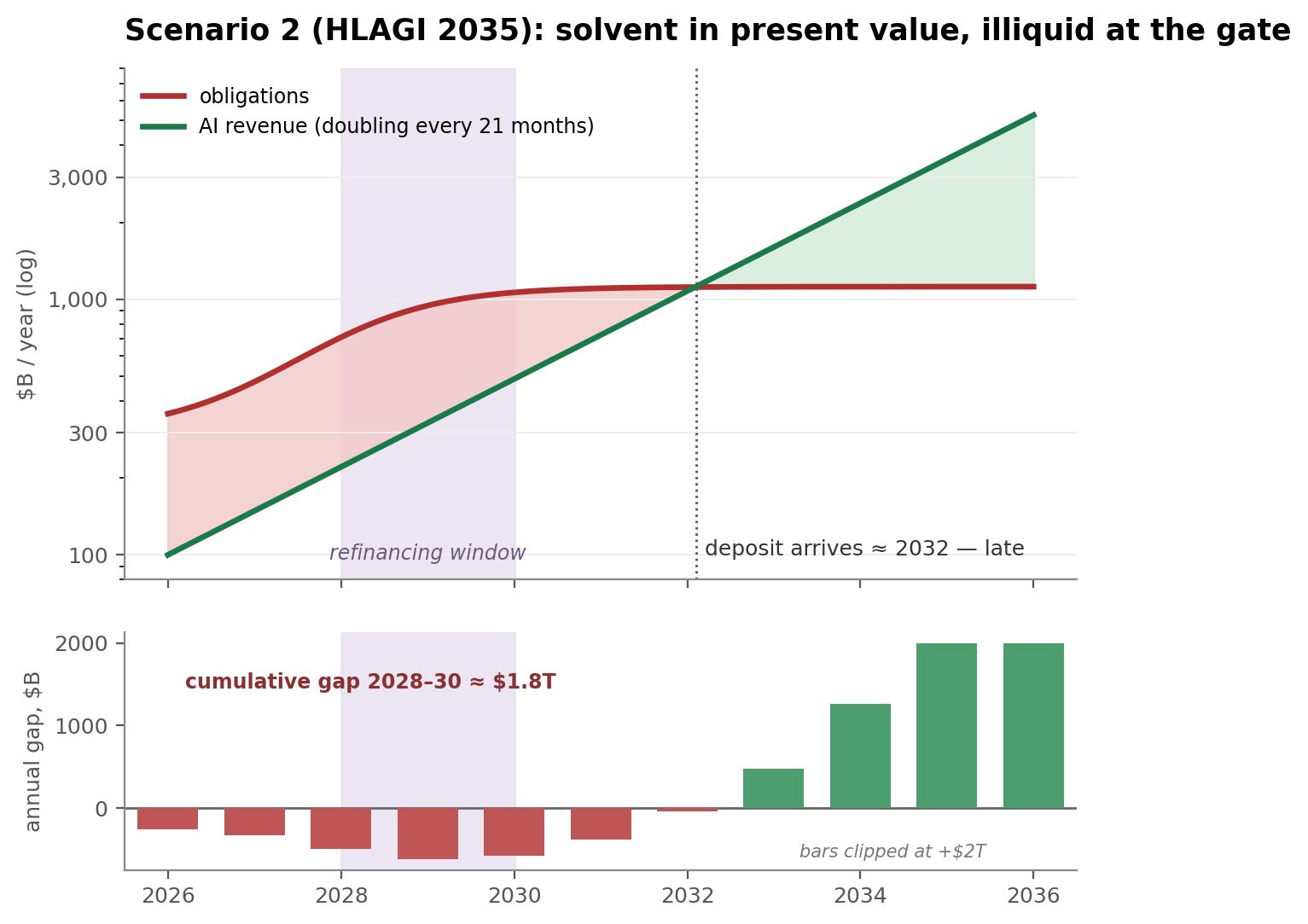
On the log scale the revenue curve is a straight line — steadily exponential — yet it crosses obligations only around 2032, three years after the refinancing window. The bars make the crisis concrete: a cumulative financing gap of roughly $1.8T across 2028–30, then abundance.
This is the historically canonical scenario, and the one where check-kiting bites hardest as a metaphor — because here the deposit is coming, and it arrives after the checks bounce. Run the arithmetic loosely: revenue growing from something like $100 billion in 2026, doubling every eighteen to twenty-four months on the way to HLAGI in 2035, crosses a trillion a year somewhere around 2031–2033. The refinancing gates fall in 2028–2030, when that curve delivers perhaps $300–500 billion — real, growing, transformative, and insufficient to service $1.5 trillion of debt plus replacement capex on a four-year depreciation cycle. Solvent in present value, illiquid at the gate; in financial markets that is a distinction without a difference.
So the modal path here, it seems to me, looks like the railway manias of the 1840s and the telecoms of 2000: a refinancing crunch around 2028–2030, large writedowns on GPU fleets and neocloud equity, losses propagating through private credit into insurers and pensions — the migration of funding from equity in 2023–2024 to structured debt in 2025–2026 being the classic late-cycle signature in Minsky’s terms — followed by consolidation as cash-rich survivors absorb distressed capacity, and a recession of moderate size, since AI capex has been carrying a disproportionate share of GDP growth and its stall is itself a demand shock.
With the sovereign already intervening, much of the crunch likely gets socialized as it happens — rolling quasi-QE, financial repression, the inflation tax as the ex-post loss-distribution mechanism instead of honest defaults — which spreads the losses onto everyone holding nominal claims, muddies price signals, and slows the cleanup. Gary’s bag-holder list — retail, pensions, banks, your mortgage rate — is roughly correct in this branch, transmitted more through the price level and the yield curve than through headline bankruptcies. Geopolitically, since deleveraging mid-race equals conceding, the bailout arrives wrapped in national security — too strategic to fail — and the US exits the crisis with a semi-mobilized, state-directed AI sector, having adopted its rival’s institutional form under duress, while China spends the same years metabolizing its own overcapacity through the state banks.
Then the second act, which in this scenario almost everyone will miss while pronouncing the technology dead: a compute overhang. The dark fiber glut of 2002 is what made Web 2.0 and cloud economics possible; a 2029–2030 glut of depreciated-but-functional accelerators collapses the price of experimentation exactly when the field needs cheap cycles for whatever paradigm reaches HLAGI — and if, as I’ve long argued, the last miles run through architectures other than pure LLM scaling, the crash is arguably accelerative for AGI. It transfers infrastructure from levered financiers to users at a discount and redirects budgets from brute-force scaling to algorithmic efficiency. Scenario 2 hands Gary a spectacular and legitimate “I told you so” about the finance, while leaving him wrong about the technology on a decade’s lag — and one expect in this sort of situation, the crash will be almost universally misread as adjudicating the AGI question, which it actually won’t at all.
Scenario 3: the deposit never arrives
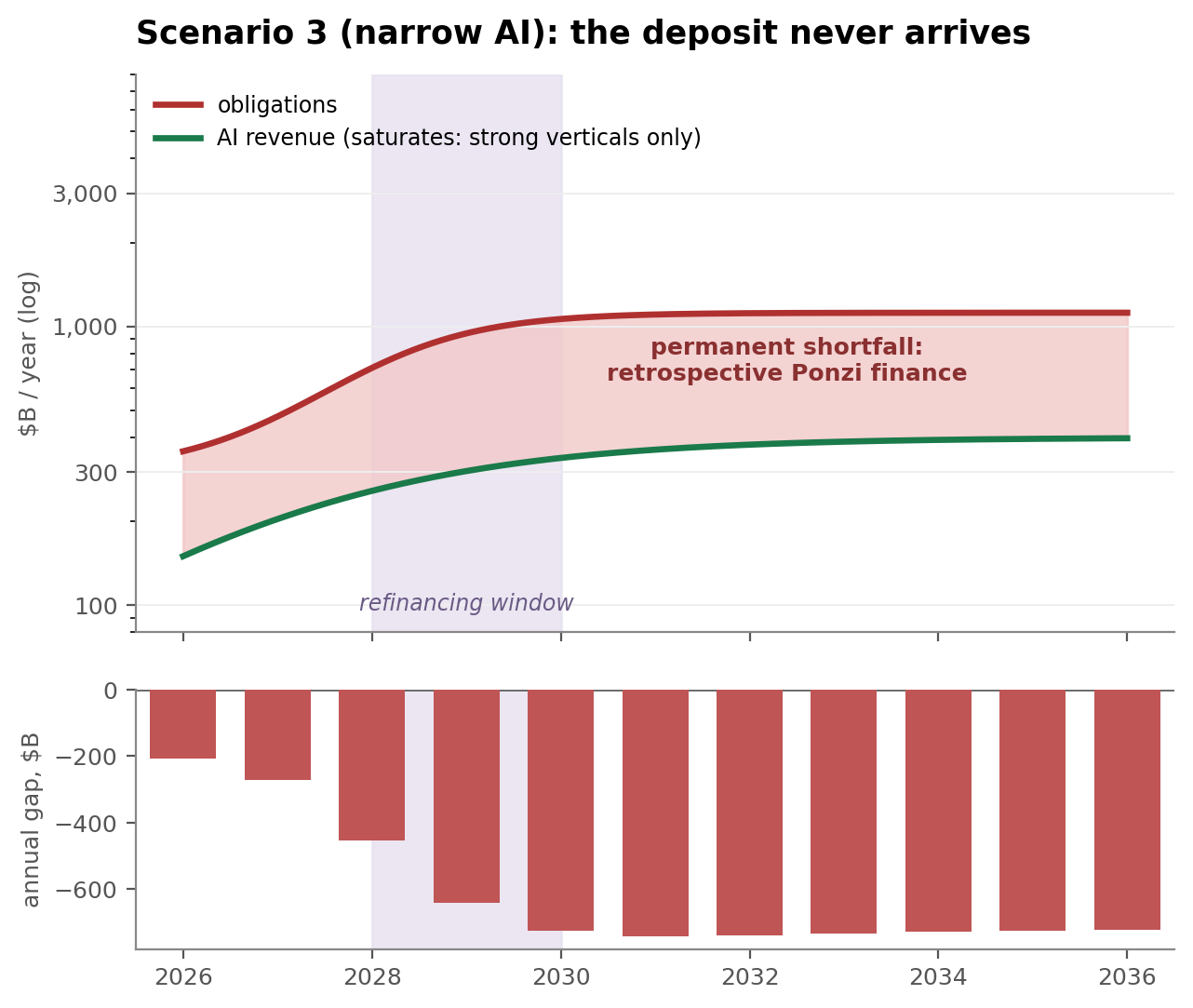
Revenue saturates at the scale of a few strong verticals; the shortfall never closes — roughly $700B a year against the obligation plateau, indefinitely.
This is a scenario I personally find highly unlikely – I don’t think LLMs will get us all the way to AGI, but I think they will be part of the story and will give way to more robust and creative technologies (like my own Hyperon, more richly recurrent neural nets with better learning algorithms, and so forth). But for the purpose of careful and thorough economic analysis, I let’s walk through the possibility: What if commercial AI’s current capabilities are about as far as things go, at least for the next few decades?
Let’s suppose then
AI’s durable franchises top out at software development, media production, some scientific workflows and customer operations — a steady state of perhaps $300–500 billion a year at competed-down margins —
Today’s real, fast-growing inference demand to saturate rather than compound — a claim about diffusion, not just about capability ceilings. The evidence for a diffusion ceiling is much weaker than the evidence Gary marshals against scaling maximalism … but let’s assume….
In this case, against a cumulative buildout approaching two trillion dollars on short-lived assets, a rough calculation says we get a trillion-plus in present-value capital destruction … and the whole circular financing structure really was Ponzi finance in Minsky’s sense, in retrospect: obligations serviceable only by new inflows. The loss distribution then does most of the work. The hyperscalers survive impaired, having funded much of this from operating cash flow, roughly as the surviving telcos ate WorldCom’s fiber. The fragile ring — neoclouds, data-center SPVs, private-credit vehicles, merchant power projects, the memory and packaging supply chain — takes the defaults.
The macro picture here is a real recession, probably deeper than Scenario 2’s because there is no recovery narrative to cushion it, landing on a sovereign that has already spent fiscal credibility defending the bubble at $40 trillion of debt and elevated rates — shading from “bad recession plus AI winter” toward a sovereign-credibility event, with the Treasury’s buybacks remembered exactly as Gary frames them, the last check in the kite.
Internationally this branch is probably nastier than it first appears, because the race was run over an overestimated prize — the missile-gap pattern — and bubble collapses historically intensify protectionism and blame: 1929 begat Smoot-Hawley, and each polity will explain its losses as the other’s sabotage, so the trade war likely escalates just as its strategic rationale evaporates.
In this world, the buildout also leaves dual-use residue — grid capacity, drone-relevant autonomy, an enormous compute stock — so Scenario 3 defuses the ASI race while arming both sides for the conventional one, in a mutual recession, with maximal mutual grievance.
One consolation: the compute overhang appears here too, delivering the cheapest research cycles in history to whoever remains funded to use them — though the accompanying AI winter means almost nobody is, and non-LLM AGI research gets punished for the sins of LLM overpromising.
Enter deAGI
Now let’s make things more interesting (“may you live in interesting times”, etc.) and change one assumption. Suppose decentralized AGI succeeds strongly — concretely, something like Hyperon running on ASI:Chain across a global network of nodes in many nations, drawing on heterogeneous and largely previous-generation hardware, funded by token economics rather than debt, with Big Tech in the US and China playing catch-up while the open network sits slightly ahead of the corporate frontier, roughly the way one or two leading labs sit slightly ahead of the pack today.
The reason this assumption transforms the analysis rather than merely adding a competitor is that everything above was ultimately about capital structure, and a substantially-token-funded open network has a different one along at least five dimensions.
In this decentralized, tokenized scenario, there is no float: capital formation is equity-like and continuous, contributors bear risk directly, capacity is paid as it is used, and there are no maturity dates on which the structure can be called — in Minsky’s taxonomy the network is confined by construction to hedge finance, since no mechanism exists for obligations to outrun cash flow. Its failure mode is degradation rather than default: a falling token price causes node operators to exit at the margin and capacity to shrink elastically, instead of a levered entity hitting a covenant and liquidating discontinuously. Its supply curve is the aggregate of the world’s already-amortized compute priced near marginal cost, which makes the network structurally short the frontier-scarcity premium — the exact quantity that Nvidia’s valuation, the memory complex, and the whole debt structure are long.
A decentralized frontier destroys the rents the float is priced on independently of whether AGI arrives, because the American debt requires not merely that AI succeed but that its returns be capturable by the entities holding the capex — and if the leading capability is a protocol rather than a firm, frontier margins compress toward zero while surplus flows diffusely to users, applications, and token holders. And the network is the natural buyer of the wreckage: in any branch where the levered structure cracks, distressed GPUs flow out of neoclouds and SPVs at fire-sale prices, and the one architecture designed to absorb heterogeneous previous-generation hardware at scale is this one. The network holds, in effect, a short position on the bubble with positive carry.
One more structural effect, at the level of the states: a jurisdictionally unownable network in the lead removes the winner-take-most premise that made Full Kelly the equilibrium. Neither state can win by outspending the other if the frontier sits outside both — which deflates the capex race and redirects it toward influence over the network: validator stake, token accumulation, developer ecosystems, governance politics. That contest is orders of magnitude cheaper than the one it replaces, and so — by the rent-dissipation logic of section 3 — vastly less wasteful. Perversely, a leading decentralized network may be the only configuration that lets both superpowers off the Full Kelly hook without either conceding to the other.
Scenario 1 + deAGI: scenario-1 technology, scenario-3 finance
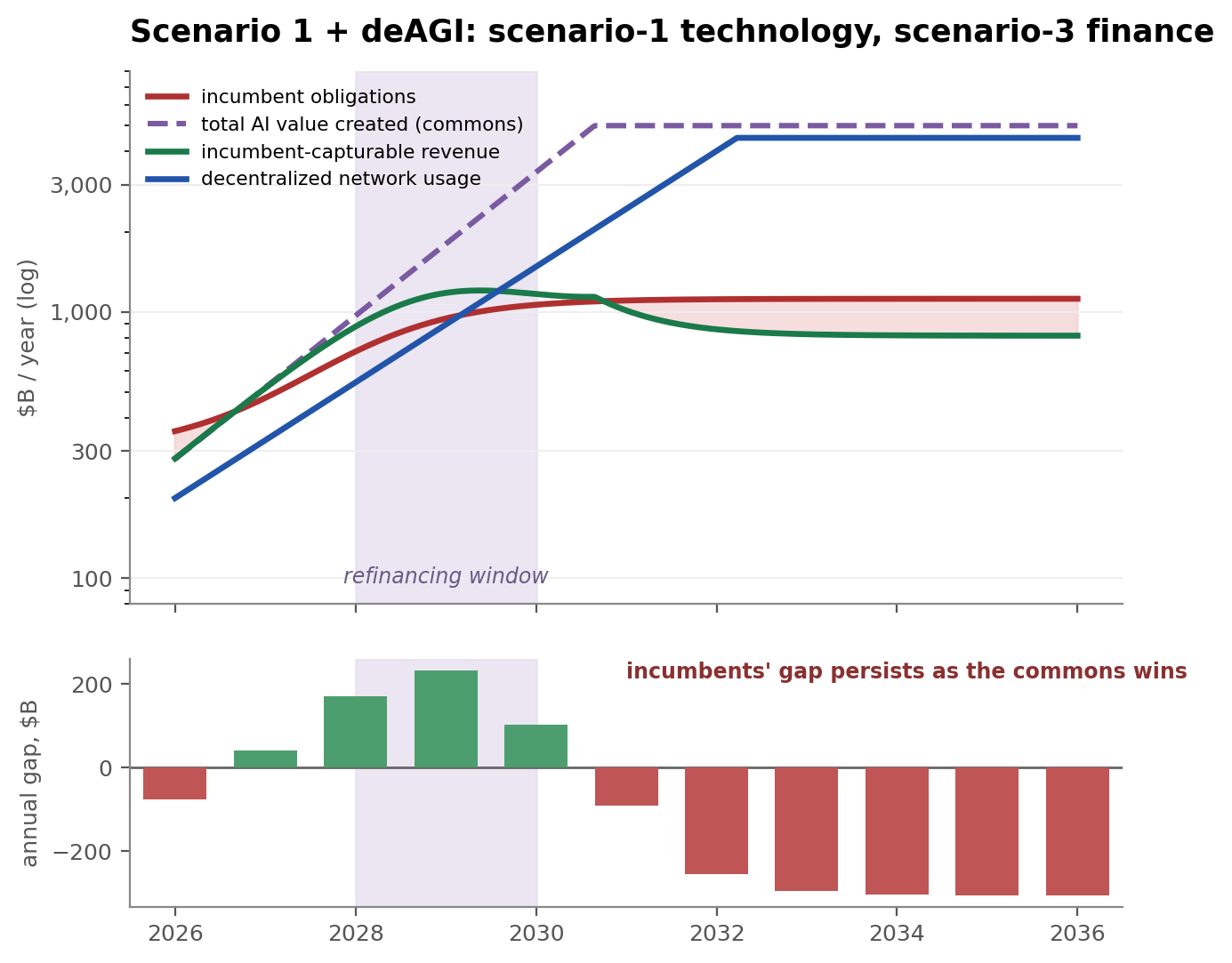
Total AI value (dashed) explodes, but incumbent-capturable revenue is compressed as the frontier commoditizes: the incumbents briefly clear the gates, then the gap turns permanently negative even as the commons wins — the deposit clears into someone else’s account.
With the network slightly ahead on the fast path, HLAGI arrives as commons rather than property, and the headline result follows immediately: the technology wins while the incumbents’ financial claims don’t. Total value created explodes; incumbent-capturable revenue — the thing that services the debt — stays compressed; the deposit arrives and clears into someone else’s account. For the world this is arguably the best branch on the board: faster diffusion, more consumer surplus, less monopoly, and a transition in which network participation itself offers a primitive answer to the wage-displacement problem that the hyperscaler architecture has no answer to at all. For the levered complex it is the worst — worse than the bipolar version of Scenario 1, where at least expropriation-by-mobilization implied the claims had value worth seizing.
Geopolitically, the parity instability softens in one respect and hardens in another: you cannot preventively strike a protocol the way you can strike a datacenter or a lab, but the plausible state response to a leading network is the one thing Washington and Beijing could agree on — joint hostility prosecuted through the chokepoints that do exist, fiat on-ramps, prominent developers, cooperative jurisdictions, and the fabs, since reduced dependence on the latest node is not independence from the fab ecosystem. The Taiwan covariance shrinks; it does not vanish.
Scenario 2 + deAGI: the crash feeds the network
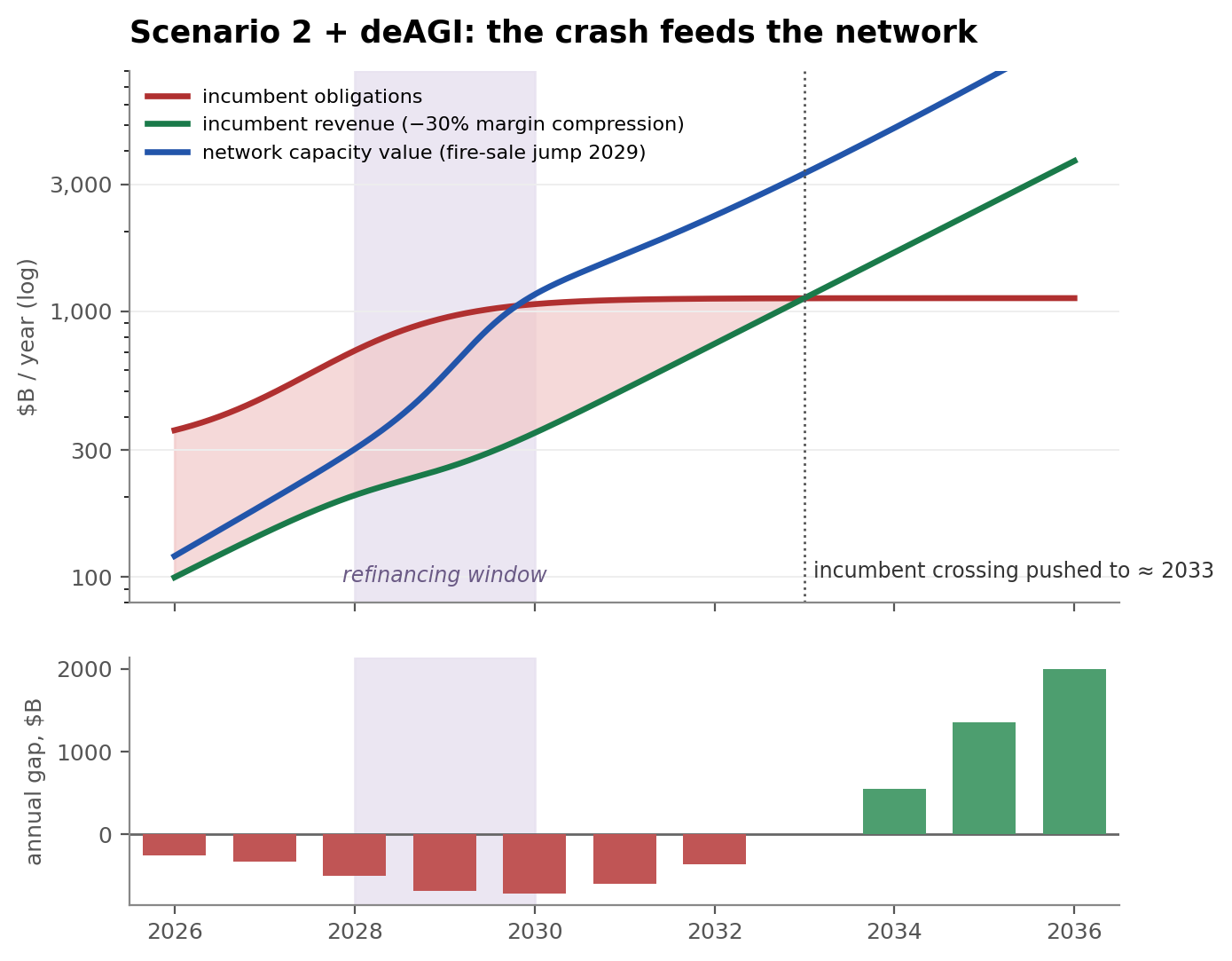
Open-network margin compression deepens the incumbents’ shortfall and pushes their crossing to roughly 2033, while fire-sale hardware jumps network capacity through the crunch.
This is where decentralized leadership compounds most powerfully, because the 2028–2030 crunch acquires an asymmetric beneficiary. Big Tech playing catch-up must justify continued frontier capex against visibly compressed future margins, which makes the refinancing gates harder to pass, deepens and probably advances the crunch, and accelerates the hardware exodus to the network — the crash feeds the thing it was supposed to refute. The too-strategic-to-fail bailout logic weakens when the frontier is demonstrably elsewhere, and the state-capitalist convergence of the base scenario gets redirected into subsidized national champions racing to catch a protocol, which is the incumbent-telecoms-versus-the-Internet pattern, and we know how that ended. In the bifurcated world of the trade war, the network also wins the third-market diffusion battle nearly by default: the Gulf and the Global South face a choice between American infrastructure with alignment strings, Chinese infrastructure with its own special “strings with Chinese characteristics”, and a neutral network with none — the non-aligned majority of the world has a structural preference for the option that doesn’t require picking a bloc.
And there is a macro dividend here that might please even Gary: to the degree capex shifts from debt-financed hyperscaler buildout toward pay-as-you-go token flows, AI stops crowding the Treasury market, the interest-rate feedback loop unwinds, and the sovereign entanglement problem partially dissolves — not through bailout but through disintermediation.
Scenario 3 + deAGI: the structure that didn’t bet its existence
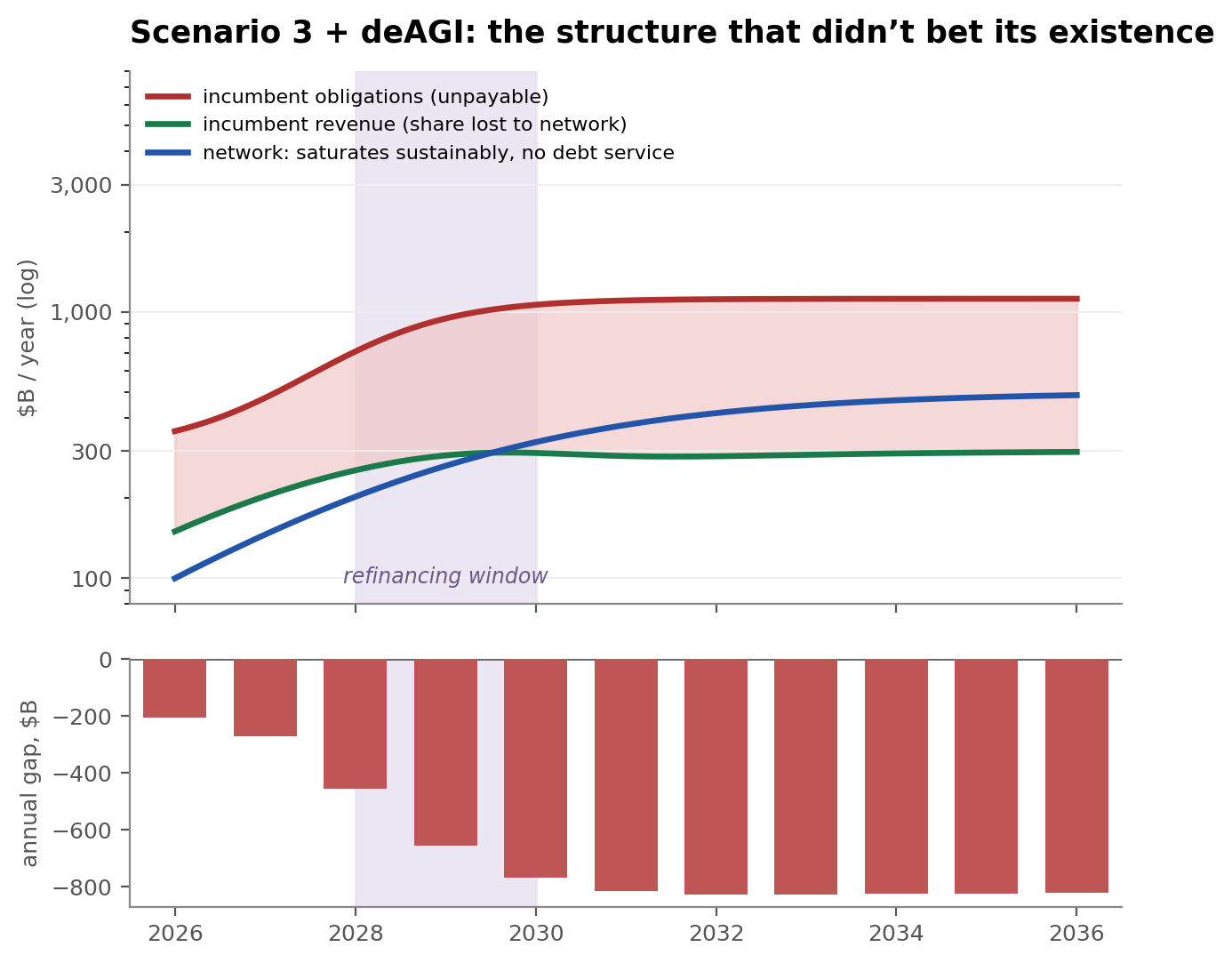
Everything plateaus — but the debt-free network saturates at a sustainable size while incumbent revenue sags below an unpayable obligation plateau; the bars are the incumbents’ permanent gap. The network has no bars to show: it owes nothing.
Finally – suppose the pessimists are right and every architecture, decentralized ones included, plateaus — the network merely a bit ahead of a disappointing pack. Now cost structures decide everything, and in a commoditized narrow-AI world of thin margins, the sustainable provider is the one with no debt service, no frontier-hardware treadmill, and elastic capacity: the network is close to the minimum-cost producer of exactly the commodity inference the surviving verticals consume. Token valuations crash from AGI-hype levels, certainly, but the network shrinks gracefully to its economic size while the levered complex shatters around it. In Kelly terms this is the punchline of the whole essay: the states went Full Kelly, and the decentralized architecture is intrinsically a fractional-Kelly position — modest continuous stakes, no ruin branch — which wins Scenario 3 not by being right about AGI but by being the only structure that didn’t bet its existence on it.
Pulling the threads together….
The main point I’ve wanted to make with the crude economic calculations presented here is: the financial crisis Gary anticipates is over-determined — it is the modal outcome under fast timelines, moderate timelines, and pessimistic ones alike … differing across scenarios mainly in what comes after. If such a financial crisis does indeed unfold, it therefore carries almost no information about the technological question, however loudly it might be interpreted as settling it.
The over-bet on LLM infrastructure that makes the crisis likely is not a lapse of prudence but the equilibrium of a two-player race, which no amount of correct prudential advice can undo, because the only actor who could size the position down is a pair of rivals locked in a prisoner’s dilemma whose one cooperative exit — coordination — the levered financial structure is itself priced against. Even peace, in the current architecture, is a systemic risk (an observation that will be incredibly unsurprising to anyone who has studied the history of capitalism and military adventure…).
Gary’s essay diagnoses Full Kelly and stops at “we’re all screwed” – and we MIGHT of course all be screwed (via these economic dynamics or some other small problems like rogue AGI etc., but let’s not digress…) …. But follow his own Kelly logic one step further and it points to a different conclusion: if the problem is that every existing structure has bet its survival on one branch of the future, the remedy is an architecture whose downside is bounded by its intrinsic design and dynamics — no float, no refinancing gates, elastic capacity, graceful degradation, and a claim on the upside of every scenario including the one where it inherits the wreckage of the others.
Such an architecture exists – or at least is being built by a whole community of us, aggressively and not hypothetically. This extends the obvious irony of Gary’s “Leopold’s Folly” theme … the man who did the most to securitize the race also demonstrated, at personal expense, precisely why the winning position was never the levered one — and the more sensible fractional-Kelly bet on the future was sitting outside the hyperscalers, on a global network that nobody owns, the whole time.
It occurs to me that decentralization in a scenario of collapsing business models that drive investments in datacenters, has characteristics of an "antifragile" strategy (as coined by Nassim Taleb). In this case not just for an organization, but for the population at large. With the addition that it would still pay off in an oligopoly of big tech, and not only for economic reasons!
Radical decentralization does require a tolerance for giving up control, which goes hand in hand with a measure of tech-optimism. Or at least the conviction that the odds for positive outcomes in a decentralized world are higher than those in a state or big tech controlled society (to which I subscribe).
There are no risk-free options. Humans often don't respond well to accumulation of personal power. Distributing governance and agency while taking the big AI leap (assuming it is unavoidable in practice anyway) seems the most prudent of the available scenarios. For economic ánd existential reasons.
Gary has a deep-seated neediness to be proven right. He gleefully does victory laps any time the usual ups and downs point to some direction even remotely consistent with what he thinks.
This made Gary quite oblivious to just how big of a deal LLM have been. Now he self-congratulates himself because agents use tools (neurosymbolic, hehe), after spending years mocking this very approach as dead end.
The measured approach here, which Ben points out, is that the cautious optimists are usually right, longer term. This was true for self-driving cars, for neural nets for perception, and now for AI agents.
Giant bets on singularity are doomed to result in disappointment. But skeptics are very wrong. The revolution due to AI is barely starting. A correction is likely but the techniques are very powerful and many companies will do very well.